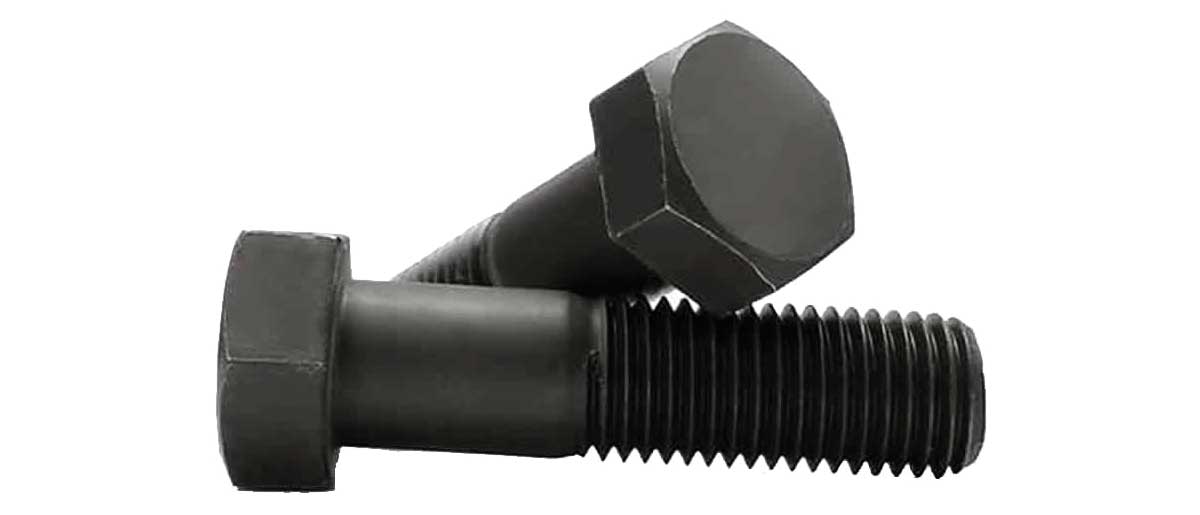
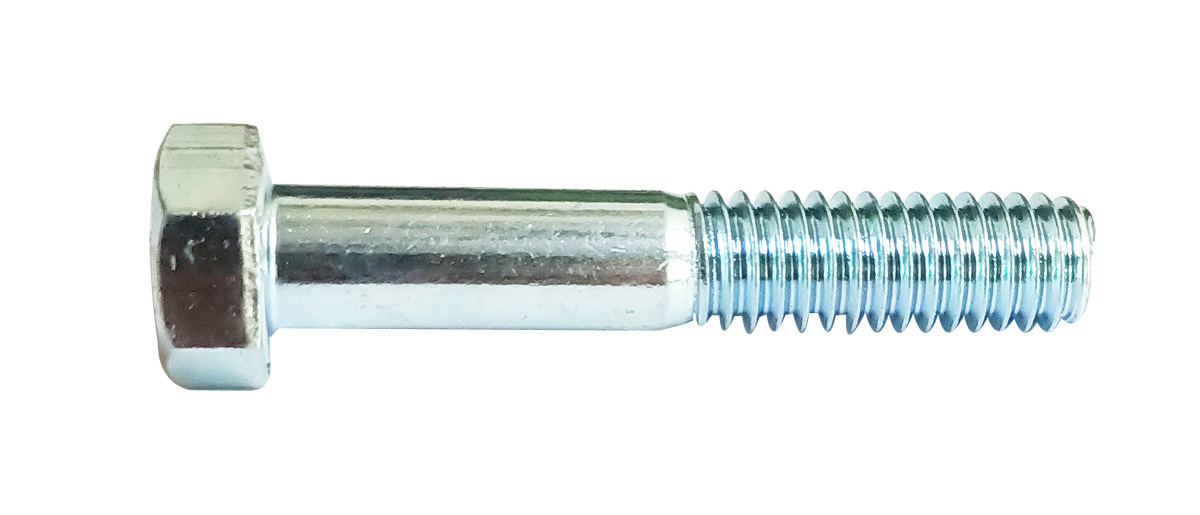
EN 14399-1 Preloaded Structural Bolt Assembly
Equivalent Standard: ISO 3269
The EN 14399 Structural Bolt Assembly series specifies the standards requirements for preloaded high-strength structural Bolts, Nuts, and Washers assembly for preloading. EN 14399-1 is the European standard for preloaded high-strength structural bolting assembly emphasizes that bolts, nuts, and washers are a system designed to work together. Components must be supplied and used as matched assemblies conforming to the same specific part of EN 14399. The bolts are tightened to a specified preload to ensure joint integrity under dynamic loads.
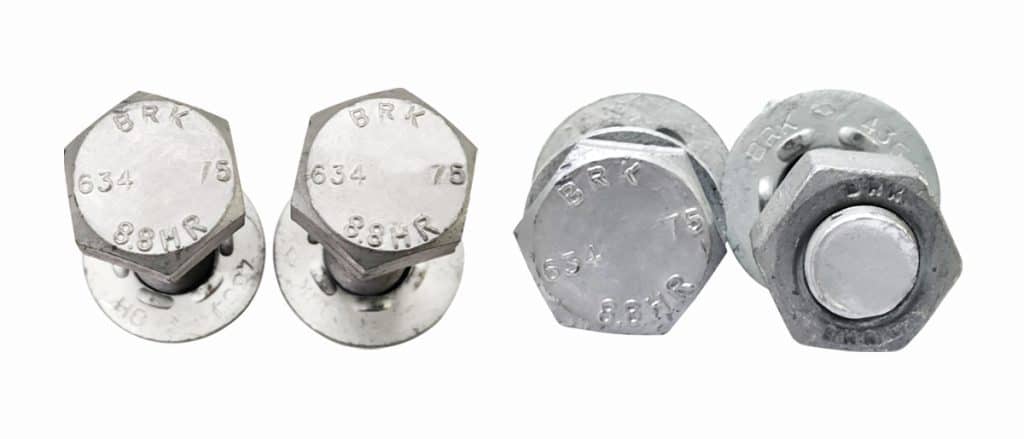
Key Components of an EN 14399-1 Structural Bolt Assembly
- Bolts: A high-strength bolt, often with a large head and specific thread length. The Bolt with a specified minimum tensile strength of 1000 MPa and minimum yield strength of 900 MPa.
- Nuts:A corresponding high-strength nut designed to match the bolt’s thread and strength properties Must have a specified minimum hardness and proof load.
- Washers: Hardened steel washers are mandatory. They prevent damage to the connected material during tightening and help ensure consistent preload distribution. Their hardness is strictly controlled.
It is essential that all these components are supplied by the same manufacturer and are tested together as an assembly to ensure their compatibility and performance under preloading conditions.
Material & Grades
Component | Material Grade | Standards |
Bolt | 8.8 or 10.9 | ISO 898-1 |
Nut | 8 or 10 | ISO 898-2 |
Washer | Hardened steel (HRC 35-45) | EN 14399-5 |
Key Features of EN 14399 Bolting Assemblies
✔ Preloaded (Tensioned) – Bolts are tightened to a controlled preload to resist slippage.
✔ High-Strength Grades – Typically 8.8 and 10.9 (HV – High Strength).
✔ Slip-Resistant Connections – Prevents movement between connected parts under load.
✔ HV (High Strength) System – Includes bolt, nut, and hardened washers.
✔ Corrosion Protection – Often hot-dip galvanized (HDG) or Dacromet-coated.
EN 14399 Sub-Standards (Different Systems)
EN 14399-2 focuses on the conformity evaluation procedures for EN 14399 assemblies. EN 14399-2 defines the testing procedures to verify that a Preloaded Structural bolting assembly (Bolt, Nut, and Washer) for Both HV & HR Series is capable of achieving the specific preload and required Tension.
EN 14399-3 refers to EU standards for HR (High Resistance) bolts with large hexagonal head Bolt assemblies. This standard provides the detailed specifications, dimensions, and performance criteria for the components (bolt, nut, and washers) that form an HR type high-strength structural bolting assembly for preloading, ensuring consistency and reliability.
EN 14399-4 stands for “Hochfest Vorgespannt,” which translates to “high-strength preloaded” in German. This indicates that the bolt and nut assembly are designed to be tightened to a specific preload, creating a high-strength connection.
Standard | System | Bolt Type | Nut Type | Washer Type |
EN 14399-1 | General requirements | – | – | – |
EN 14399-2 | Suitability Test for Preloading | – | – | Ensures assembly performs correctly under preload |
EN 14399-3 | HR System | HR bolt (DIN 6914) | HR nut (DIN 6915) | Bevel washer (DIN 6917) |
EN 14399-4 | HV System | Bevel washer | ||
EN 14399-5 | Plain Washers | – | – | DIN 434 / ISO 7089 |
EN 14399-6 | Direct Tension Indicators (DTI) | – | – | Load-indicating washers |
Marking & Identification
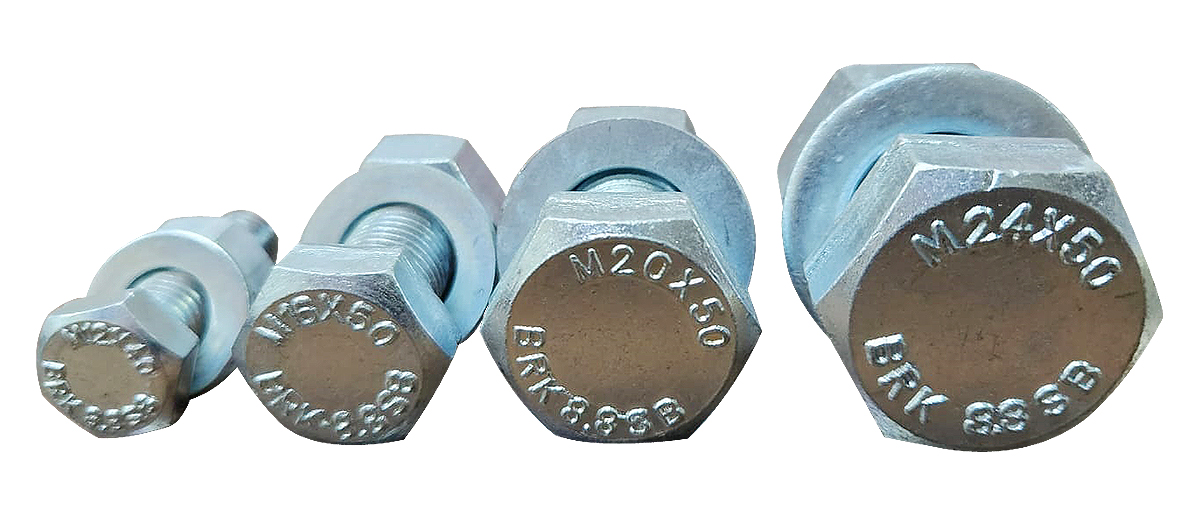
- Bolts: Head marked with grade (8.8 or 10.9) and manufacturer ID
- Nuts: Top face marked with grade (8.8 or 10.9)
- Washers: Must be clearly identifiable as hardened
Coatings For Common Corrosion Protection
- Hot-dip galvanized (HDG)
- Geomet® (zinc-flake coating)
- Dacromet
Testing & Compliance
- Bolt/nut: Proof load, hardness, tensile tests (ISO 898-1/2)
- Assembly: Preload verification (turn-of-nut or DTI methods)
Comparison to Other Standards
Feature | EN 14399-1 | ASTM A325 |
Grade | 8.8/10.9 | ASTM A325 (≈8.8) |
Preload | 0.7×Fy | 0.7×Fy |
Washers | Mandatory | Optional |
Applications of EN 14399 Bolts
- Steel bridges & seismic structures
- High-rise buildings
- Crane rails & heavy machinery
- Wind turbine towers.
EN 14399-1
BS EN 14399 is a part of the series of European standards on High Strength Structural Bolting Assemblies. used in steel construction. It specifies the general requirements for systems consisting of bolts, nuts, and washers for preloaded structural connections, particularly in slip-resistant and bearing-type joints.
Preloading Requirements
- Bolts must be tightened to a minimum preload (Fₚ,C)as specified in EN 14399-3 (HR) or EN 14399-4 (HV)
Scope of EN 14399-1
- Defines general requirements for high-strength bolting assemblies (HR – Heavy-duty Requirements).
- Applies to structural bolting systems with controlled preload (used in bridges, buildings, cranes, etc.).
- Covers bolts, nuts, and washers conforming to subsequent parts of EN 14399 (e.g., EN 14399-2 to EN 14399-10).
EN 14399-1 is essential for high-strength bolted connections in structural steelwork, ensuring safety, slip resistance, and durability. Proper selection of bolts, nuts, and washers (from EN 14399-2 to EN 14399-10) is crucial for compliance.

Technical Specification for EN 14399-1 High Structural Bolts
| Thread d | M12 | (M14)b | M16 | (M18)b | M20 | M22 | M24 | M27 | M30 | M36 | |
| P c | 1.8 | 2.0 | 2.0 | 2.5 | 2.5 | 2.5 | 3.0 | 3.0 | 3.5 | 4.0 | |
| b (ref.) | d | 30 | 34 | 38 | 42 | 46 | 50 | 54 | 60 | 66 | 78 |
| e | — | 40 | 44 | 48 | 52 | 56 | 60 | 66 | 72 | 84 | |
| f | — | — | — | — | 65 | 69 | 73 | 79 | 85 | 97 | |
| c | Max. | 0.8 | 0.8 | 0.8 | 0.8 | 0.8 | 0.8 | 0.8 | 0.8 | 0.8 | 0.8 |
| Min. | 0.4 | 0.4 | 0.4 | 0.4 | 0.4 | 0.4 | 0.4 | 0.4 | 0.4 | 0.4 | |
| da | Max. | 15.20 | 17.20 | 19.20 | 21.70 | 24.40 | 26.40 | 28.40 | 32.40 | 35.40 | 42.40 |
| ds | Max. | 12.70 | 14.70 | 16.70 | 18.70 | 20.84 | 22.84 | 24.84 | 27.84 | 30.84 | 37.00 |
| Min. | 11.30 | 13.30 | 15.30 | 17.30 | 19.16 | 21.16 | 23.16 | 26.16 | 29.16 | 35.00 | |
| dw | Max. | g | g | g | g | g | g | g | g | g | g |
| Min. | 20.10 | 22.00 | 24.90 | 27.70 | 29.50 | 33.30 | 38.00 | 42.80 | 46.60 | 55.90 | |
| e | Min. | 23.91 | 26.17 | 29.56 | 32.95 | 35.03 | 39.55 | 45.20 | 50.85 | 55.37 | 66.44 |
| k | Nom. | 7.50 | 8.80 | 10.00 | 11.50 | 12.50 | 14.00 | 15.00 | 17.00 | 18.70 | 22.50 |
| Max. | 7.95 | 9.25 | 10.75 | 12.40 | 13.40 | 14.90 | 15.90 | 17.90 | 19.75 | 23.55 | |
| Min. | 7.05 | 8.35 | 9.25 | 10.60 | 11.60 | 13.10 | 14.10 | 16.10 | 17.65 | 21.45 | |
| kw | Min. | 4.90 | 5.85 | 6.50 | 7.42 | 8.10 | 9.20 | 9.90 | 11.30 | 12.40 | 15.00 |
| r | Min. | 1.2 | 1.2 | 1.2 | 1.5 | 1.5 | 1.5 | 1.5 | 2.0 | 2.0 | 2.0 |
| s | Max. | 22 | 24 | 27 | 30 | 32 | 36 | 41 | 46 | 50 | 60 |
| Min. | 21.16 | 23.16 | 26.16 | 29.16 | 31.00 | 35.00 | 40.00 | 45.00 | 49.00 | 58.80 | |
Offshore & marine structures
Comparison: EN 14399 vs. EN 15048
Feature | EN 14399 (Preloaded) | EN 15048 (Non-Preloaded) |
Tightening | Torqued/tensioned to preload | Snug-tightened |
Slip Resistance | Required (friction grip) | Not required |
Grades | 8.8, 10.9 (HV/HR) | 4.6, 5.6, 8.8 |
Applications | Bridges, seismic zones, Wind Turbine, | General steel structures |